
The robots are coming to Bathurst Street in Toronto.
When the new surgical tower being built at UHN’s Toronto Western Hospital opens in 2028, it will have the country’s largest concentration of surgical robots under one roof. Within five to 10 years, robotics will be integral to how surgeons operate, and this new facility will help UHN’s Sprott Department of Surgery, already a North American leader in robot-assisted surgery, stay on the leading edge of innovation.
“Using robotics allows surgeons to push the boundaries of surgery even further, decreasing the severity of surgery, making procedures less invasive, and ultimately improving patient recovery,” says Dr. Allan Okrainec, director of the Temerty Advanced Surgical Education and Simulation Centre, and surgical lead, planning and infrastructure, UHN. “We’re also training the surgeons of tomorrow to be able to offer this kind of innovative technology.”
Take a look inside the tower to see how robotics, AI and simulation training are transforming surgery at UHN:
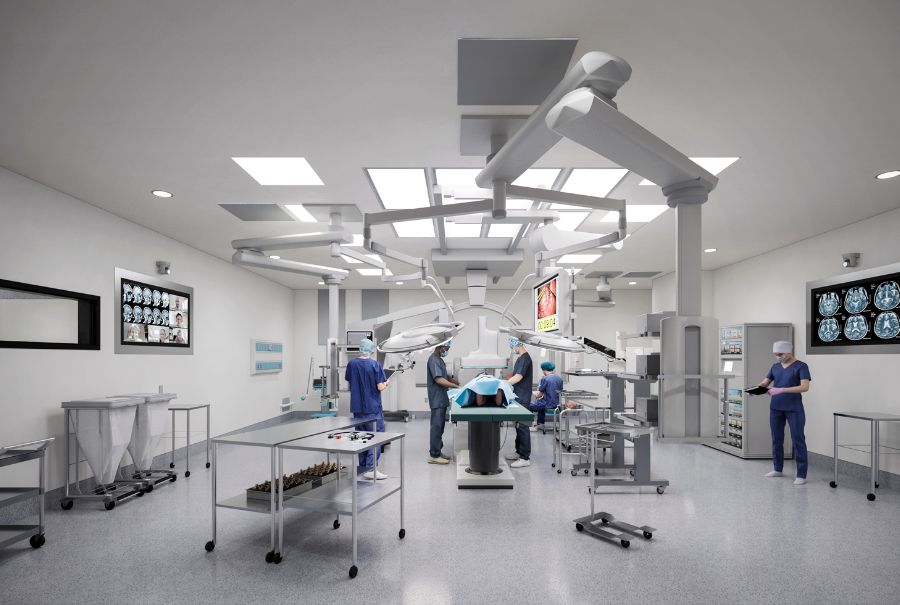
Robots supercharging surgical teams
UHN’s new surgical tower represents a future where innovation and compassionate care converge.
When the 15-storey tower opens in 2028, it will house 20 new operating rooms across three floors, boosting surgical capacity by more than 50 per cent, reducing patient wait times and helping address the surgical backlog with safer, more efficient procedures.
Inside those operating rooms will be the very latest in robotics technology, including Da Vinci XI robots, the world’s most widely used multiport robotic surgery system.
Robotics already enables UHN surgeons to do more precise orthopedic surgeries, such as hip and knee replacements that have patients walking out of the hospital the same day, says Dr. Christian Veillette, division head, orthopedic surgery at UHN’s Sprott Department of Surgery and Schroeder Arthritis Institute.
“It empowers us to make highly specific cuts or position implants with an accuracy that simply wasn’t possible before.”
It’s important to note that these machines aren’t replacing surgeons; rather, robotics augments their abilities, benefitting patients in new ways beyond the most expert surgical teams.
“Not only will the new tower have innovation we’re working with today, but also concepts, procedures and technology we haven’t even developed yet,” says Dr. Jason Lee, lead of the Robotics Academy and a urologic and kidney transplant surgeon at UHN. “I’m excited that we will be able to provide additional capacity for robotic surgery – not only the robots of today, but the robots of the future.”
Dr. Kasey Berscheid, a fourth-year urologic surgery resident at the University of Toronto who recently completed a surgical rotation at UHN, says most surgical specialties are moving toward robotic surgery or minimally invasive surgery. “I think having as many tools in your toolkit for patients is really important,” she says. Robot-assisted surgery allows patients to have less invasive surgery, less post-operative pain and go home much sooner.
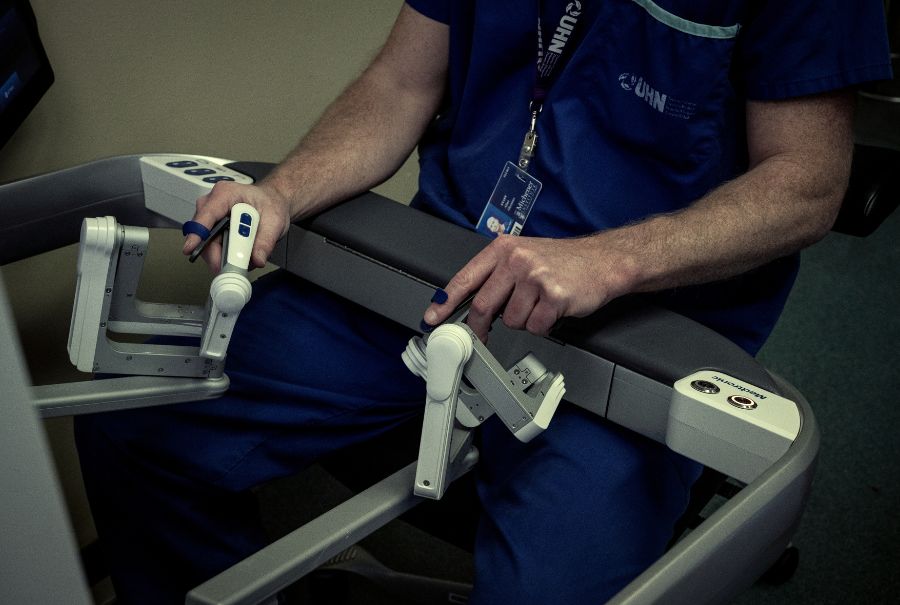
AI as an operating room co-pilot
With its ever-growing robotic fleet, UHN is leading the “digital surgical revolution” – the convergence of robotic surgery, artificial intelligence and image-guided navigation shaping tomorrow’s medical procedures.
In the future, AI will serve as a critical decision-making component in advanced robotic surgeries, helping guide the entire surgical team in real time. It will be like having the world’s most knowledgeable surgical navigator at the surgeon’s side.
“If I’m doing an operation where AI has already learned the critical anatomy, I can overlay that knowledge onto the surgical image I’m looking at,” says Dr. Okrainec. “This has the potential to guide a surgeon during the operation, identifying safe and unsafe areas of the surgical field.”
AI can optimize what surgeons do, says Dr. Berscheid, improving precision and surgical outcomes in the toolbox of the future.
For example, surgeons can use AI to merge different imaging techniques while operating. In the oncology world, that means “being able to map out where the tumour is and get real time feedback,” Dr. Berscheid says.
Simulation training to hone skills
The new surgical tower will be a major training hub for a new generation of surgeons – not only in Toronto, but worldwide.
UHN’s Michener Institute of Education, Canada’s only post-secondary institution dedicated exclusively to health sciences education, has built a state-of-the-art, robotic-assisted surgical training program. Meanwhile, at UHN’s Temerty Advanced Surgical Education and Simulation Centre, surgical teams get to practise their skills on the latest robotics technology. The facility replicates an operating room – only it has no patients.
“Through advanced simulation and tele-mentoring, we are able to train tomorrow’s surgeons in robotic surgery and other minimally invasive techniques,” says Dr. Lee.
Once complete, digital integration in the new tower will enable learners to train on identical tower equipment, mastering minimally invasive surgery, neurosurgery, orthopedics and robotics in Michener’s simulated environments before applying techniques in the tower’s live operating rooms.
“The tower itself is going to create an environment that fosters learning with some of the most advanced robotics technologies and connected surgical environments,” says Dr. Veillette. “This will attract some of the best and brightest minds and enable them to become leaders in the field.”
Dr. Berscheid has done training with robotic simulation sessions and says the experience is invaluable to her career. “It’s a really great resource [for] learning to happen in a pressure-free and safe environment,” she says.
In addition, the top-of-the-line surgical robots have a simulation feature offering modules for a wide range of skills. So, after operation hours are finished for the day, residents can book time to learn the best camera angles for a certain surgery, practise suturing and become familiar with the ins and outs of how the surgical robots operate.
“I’ve spent a lot of time practising on the simulator,” Dr. Berscheid says, adding she feels “fortunate” to have this access. “The more you practise, the better you are, and the better that is for patients.”
Learn more about how UHN is building the future of surgery at UHNfoundation.ca/tower
This article originally appeared in The Globe and Mail, read it here.

No one ever changed the world on their own but when the bright minds at UHN work together with donors we can redefine the world of health care together.