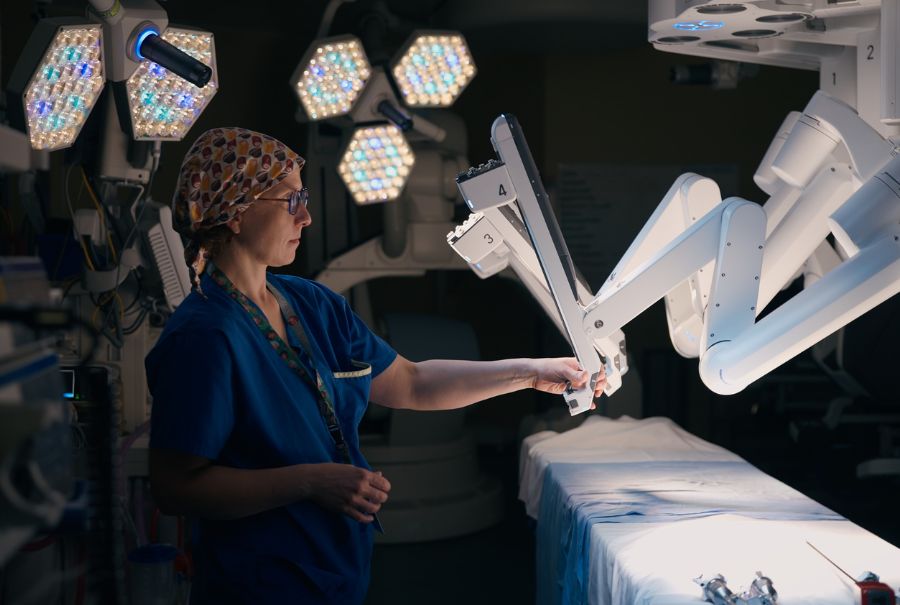
The robots are here at UHN, and more are on the way. UHN’s Sprott Department of Surgery is home to Canada’s largest robotic surgery program, and once the new surgical tower is built at Toronto Western hospital, UHN will also have the country’s largest concentration of surgical robots under one roof.
These machines aren’t replacing surgeons, they’re amplifying them by extending expert capabilities to benefit patients in new ways beyond the most expert surgical teams.
As home to some of the only robots of their kind in Canada, UHN’s advanced technology also enables surgeons to train the next generation in pioneering techniques reshaping health care.
“Using robotics allows surgeons to push the boundaries of surgery even further, decreasing the severity of surgery, making procedures less invasive, and ultimately improving patient recovery,” says Dr. Allan Okrainec, Director of the Temerty Advanced Surgical Education and Simulation Centre, and Surgical Lead, Planning and Infrastructure, UHN. “With UHN being the first to bring these newer platforms to North America, we’re also training the surgeons of tomorrow to be able to offer this kind of innovative technology.”
Supercharged technology
UHN’s innovative successes in robotics include headline-making breakthroughs in orthopedics — managing conditions of the bone, joints and spine that limit patients’ day-to-day activities. Hip and knee replacements now have patients walking out the same day.
In May 2025, Toronto Western Hospital performed Canada’s first partial knee replacement using the VELYS robot, leading-edge technology designed specifically for this surgery. Unlike traditional total replacements that substitute all three compartments of the knee, this operation targets only the affected area — preserving the healthy parts of the patient’s natural joint.
“In orthopedics, we are at the forefront of the evolution in robotic surgery, using this technology to improve patient outcomes by performing joint replacements with an exceptional level of precision,” explains Dr. Christian Veillette, Division Head, Orthopedic Surgery at UHN’s Sprott Department of Surgery and Schroeder Arthritis Institute. “It empowers us to make highly specific cuts or position implants with an accuracy that simply wasn’t possible before.”
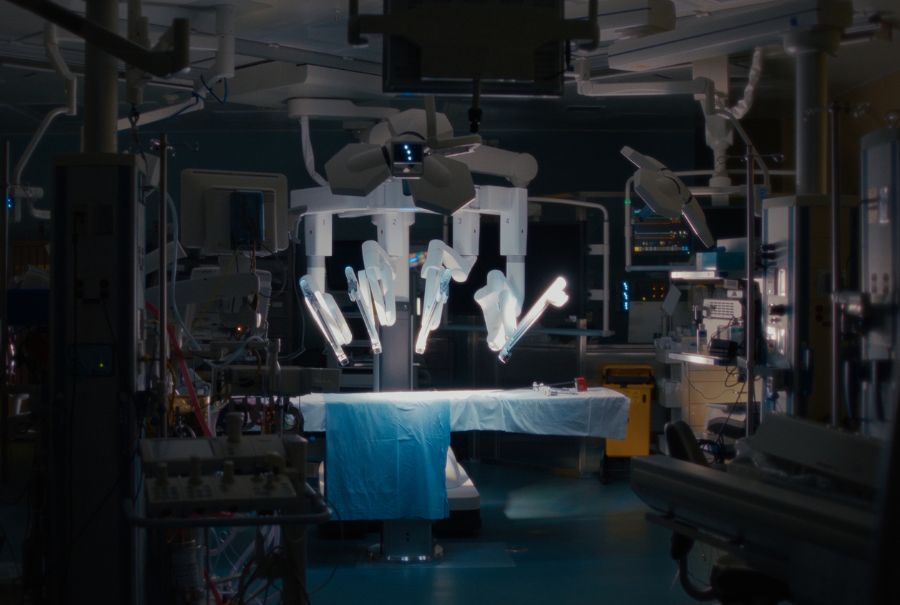
With the largest number of multi-port robotic systems in the country, UHN is also home to Da Vinci XI robots, the world’s most widely used multiport robotic surgery system. Offering interactive robotic arms, advanced instrumentation and leading-edge visualization, this advanced technology is utilized by surgeons from multiple specialities. These include general surgery, urology, organ transplantation, thoracic surgery, gynecologic oncology, colorectal, hepatobiliary and otolaryngology/head and neck surgery. With every single system, advanced visualization and control translate directly into results: surgeons operate faster, more patients are treated in a minimally invasive fashion, and people recover sooner with better outcomes.
A tower built for what’s next
In 2025, two new Da Vinci XI systems joined UHN’s robotic arsenal, extending the reach of surgical innovation. The new robots align with the robotic program’s expansion to the new surgical tower at Toronto Western Hospital — a 15-storey structure housing 20 new operating rooms across three dedicated surgical floors.
When the tower opens in 2028, it will increase surgical capacity by over 50 per cent over the next decade, reduce wait times, and address the surgical backlog with safer, more efficient procedures, setting new standards for care. The opening of the tower will see UHN being home to four Da Vinci robots, three of which will be housed in the tower itself.
“Having these additional robots now allows teams to grow and build capacity for the future, so that when the tower opens, we’ll be ready to continue expansion,” says Dr. Okrainec.
This proactive approach reflects UHN’s broader vision: building tomorrow’s operating rooms today. Within five to 10 years, robotics will be integral to how surgeons integrate and optimize technology — positioning UHN to stay ahead of innovation rather than retrofitting to catch up.
As the tower rises at Toronto Western Hospital, UHN teams look forward to dedicated spaces for an even greater variety of surgical disciplines, with rooms equipped with new surgical tools to enhance workflow. Combined with traditional rehabilitation tools, advanced robotics will also dramatically enhance robot-assisted therapy.
The AI advantage
With its expanding robotic fleet, UHN is leading the “digital surgical revolution”— a convergence of robotic surgery, artificial intelligence and image-guided navigation shaping tomorrow’s procedures.
In the future, AI will serve as a critical decision-making component in advanced robotic surgeries, helping guide the entire surgical team in real time—-like having the world’s most knowledgeable surgical navigator at the surgeon’s side.
“If I’m doing an operation where AI has already learned the critical anatomy, I can overlay that knowledge onto the surgical image I’m looking at,” explains Dr. Okrainec. “This has the potential to guide a surgeon during the operation, identifying safe and unsafe areas of the surgical field.”
Training tomorrow’s leaders
The convergence of robotic and digital technology is helping UHN make an even broader impact by training a new generation of surgeons, not only in Toronto, but worldwide.
At the Michener Institute of Education — Canada’s only post-secondary institution dedicated exclusively to health sciences education — UHN has built a state-of-the-art structured robotic-assisted surgical training program. At UHN’s Temerty Advanced Surgical Education and Simulation Centre, surgical teams hone skills practicing on the latest robotics technology.
The 15,000-square-foot facility replicates an operating room in every detail with one exception: no patients. “Simulation offers the opportunity to learn in an environment outside the operating room where the stakes aren’t as high,” explains Dr. Okrainec.
UHN has a hand in training 50% of Canada’s surgeons and every year, international fellows from around the globe train onsite and return home with new skills. Telesimulation technology beams that same expertise directly to surgeons and trainees across the globe. No transporter room required, just good internet connectivity.
At Michener, we’ve got cutting-edge operating room technology that’s even unavailable in most Ontario hospitals,” says Dr. Jason Lee, Lead of the Robotics Academy and a urologic and kidney transplant surgeon at UHN. “Through advanced simulation and tele-mentoring, we are able to train tomorrow’s surgeons in robotic surgery and other minimally invasive techniques.”
Each robotic system at UHN is equipped with virtual reality (VR) simulation capabilities and a teaching console that enables training to happen both in a VR world and in real-time, during all procedures, allowing UHN’s surgeons to better train the robotic surgeons of the future.
Once complete, digital integration in the new tower will enable learners to train on identical tower equipment, mastering minimally invasive surgery, neurosurgery, orthopedics and robotics in Michener’s simulated environments before applying techniques in the tower’s live operating rooms.
“The tower itself is going to create an environment that fosters learning with some of the most advanced robotics technologies and connected surgical environments,” says Dr. Veillette. “This will attract some of the best and brightest minds and enable them to become leaders in the field.”
Innovation without limits
UHN’s surgical tower represents a future where innovation and compassionate care converge. The robots are already transforming what’s possible at UHN, and the tower will provide an unprecedented environment to transform what’s possible for patients and health care specialists everywhere.
With UHN leading the way in robotics, one thing is clear: the future of surgery is limitless.
“Not only will the new tower have innovation we’re working with today, but also concepts, procedures and technology we haven’t even developed yet,” says Dr. Lee. “I’m excited that we will be able to provide additional capacity for robotic surgery — not only the robots of today, but the robots of the future.”

No one ever changed the world on their own but when the bright minds at UHN work together with donors we can redefine the world of health care together.