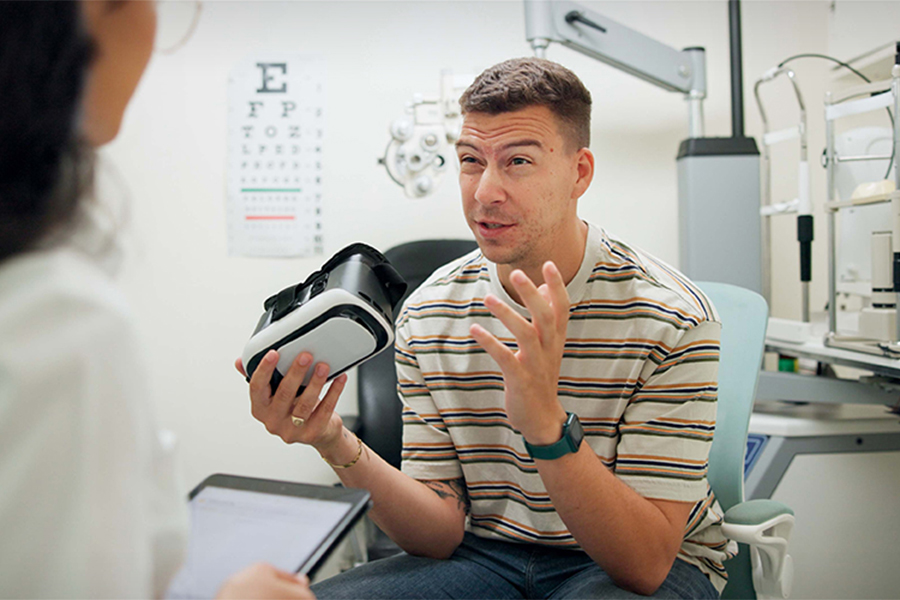
Virtual reality (VR) holds significant promise for health care, particularly in eye health.
Its immersive experience, ability to deliver care remotely and potential to collect large amounts of data through headset-mounted sensors are among its many advantages. But research on VR in vision care is still in its infancy.
Understanding what has been studied and what remains unexplored is essential for continued progress and improved outcomes.
Dr. Michael Reber, Senior Scientist at UHN’s Donald K. Johnson Eye Institute, and Dr. Lora Appel, Affiliate Scientist at UHN’s KITE Research Institute (KITE), address this need in a recent literature review published in the journal, Technologies.
The Donald K. Johnson Eye Institute and KITE teams assessed 76 studies on VR headsets as interventions for vision-related conditions. Across these studies, 31 different VR systems were evaluated.
Some focused on specific conditions — most commonly glaucoma or amblyopia — while others simulated disease symptoms in healthy participants. Most studies explored VR as a diagnostic or treatment tool and a smaller subset examined its screening potential. Notably, only 15 per cent were randomized controlled trials.
The review highlights a major challenge to widespread VR adoption in vision care: inconsistent study designs. Without standardized sample sizes, participant types and VR systems, reliable conclusions about accessibility, efficacy and usability remain elusive.
Drs. Reber and Appel also note barriers to clinical implementation, including high start-up costs and data security concerns, and propose strategies to address them.
As the first scoping review of VR as a tool in eye care, this work offers a comprehensive roadmap for future research and clinical adoption. By integrating expertise in vision care and digital health technologies, the review demonstrates how co-ordinated efforts can overcome current barriers and accelerate adoption in clinical settings.
These recommendations aim to make future studies more robust and implementation of VR into clinical settings more seamless. Ultimately, as researchers continue to explore VR and clinicians begin to integrate it into eye care, this technology has the potential to transform treatment approaches and improve accessibility for patients worldwide.
This story was originally published by Research at UHN.
This review was supported by generous donors to UHN Foundation.

No one ever changed the world on their own but when the bright minds at UHN work together with donors we can redefine the world of health care together.