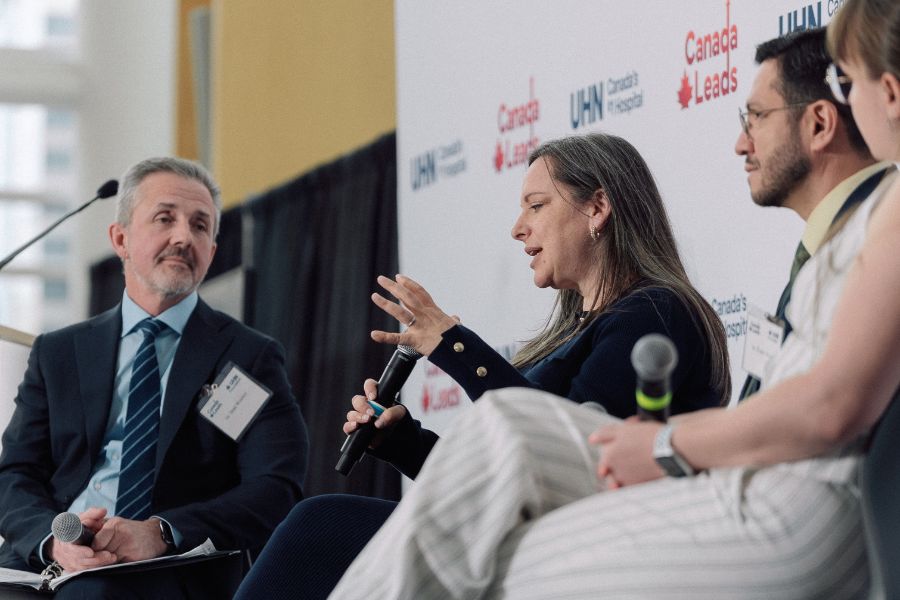
In 2025, University Health Network (UHN) launched Canada Leads, an ambitious initiative to recruit 100 world-class scientists and retain top Canadian talent to drive the next breakthrough here in Toronto. Thanks to support from UHN Foundation, that goal is now within reach, and its impact is already being felt across UHN.
For patients facing cancer surgery, understanding treatment options and feeling confident in their care can help make an overwhelming experience more manageable. Dr. Wagner Souza, a Scientific Associate in Dr. Amin Madani’s lab at UHN’s Surgical AI Research Academy (SARA), is helping make that journey clearer through artificial intelligence (AI).
From Brazil to Toronto
Originally from Natal, Brazil, Dr. Souza is a neuroscientist, clinician, and researcher focused on transforming complex medical images into tools that surgeons and patients can easily understand. He studied at the Federal University of Rio Grande do Norte, McGill University, and Johns Hopkins University before joining UHN.

“I chose Toronto because I found the right lab with Dr. Madani,” says Dr. Souza. “Our lab has remarkable people who genuinely care for one another.”
Encompassing the spectrum of patient care, education and research, Dr. Souza develops AI-powered technology that converts routine medical scans, including CT and MRI images, into personalized 3D models. Traditionally, surgeons plan complex procedures using two-dimensional images, relying on experience to mentally reconstruct a patient’s anatomy. These models provide a clearer view of tumours and surrounding structures before surgery begins.
The benefits extend beyond the operating room. Rather than interpreting complex scans, patients can see a visual representation of their own anatomy, helping them better understand their diagnosis and treatment options.
Dr. Souza’s primary research focus is breast cancer surgery. He is exploring how AI-generated 3D models can support patient consultations, surgical planning, and real-time guidance during procedures. By improving tumour visualization and localization, the technology could help surgeons remove cancer more precisely and reduce the need for repeat surgeries.
The research also examines whether these tools can improve patient understanding, strengthen trust in treatment decisions, and support shared decision-making between patients and care teams.
Making advanced care more accessible
One of the technology’s greatest strengths is its potential scalability. Because hospitals already perform these imaging studies routinely, they can adopt the technology without significant new equipment or infrastructure, making advanced surgical planning more accessible worldwide.
Dr. Souza’s commitment to improving care is deeply personal. At age 19, Dr. Souza received a diagnosis of ankylosing spondylitis, a painful autoimmune disease that affects the spine and other parts of the body.
“I got very sick, and neither I nor my doctors knew what was happening,” he says. “My doctors said I would be lucky to reach my thirties. Here I am 13 years beyond my expiry date.”
Living with chronic pain has only strengthened his dedication to research and patient care.
“It’s inspiring to see innovation translating into meaningful impact for patients and care teams. I’m very honoured to be part of TeamUHN and grateful for the opportunity.”